Script

Only with your donations am I able to continue this blog. Please
consider donating.

Wednesday, January 4, 2012

Children Need Less Computer Time, Argues Expert


Children's reading and conversational skills are being put at risk due to the overuse of devices such as smartphones and computers, according to Independent Schools Council's Barnaby Lenon.

“Parents should resist buying sons and daughters a smartphone until they are at least 15 and limit computer use to an hour or two a day” he said. He continues on to say “Exposure to computers was particularly damaging to boys, harming their long-term development. Far too many children, and particularly boys, become quite addicted to computer use...It is very hard to prevent children from accessing damaging material through the computer, but the main issue is that children spend far too long on computers and, as a result, they are not doing the two things that we want [them] to do, which are reading and conversation.”

Instead he advises parents to keep their children's use of computers, televisions, and other such devices to about one hour a day until around age 12 and two hours for older ages.

He also requested schools to use multiple choice questions more often in exams because they are less susceptible to errors and cover more of the syllabus.

Pakistani Militant Groups Unite Against NATO.

Islamabad – A cease-fire was pledged to Pakistani security forces from Pakistani fighters on Sunday, but is also joining forces with the Taliban to attack NATO forces in Afghanistan.

Security experts say the agreement, which reunites four major militant factions under the under Taliban chief Mullah Mohammed Omar, was “a dual-purpose tactical move by the Taliban, which has lost hundreds of fighters during a two-year surge of U.S. forces in its Afghanistan strongholds.”

The deal between the groups also swells the Taliban's ranks and allows them the ability to launch more attacks into Afghanistan.


The unification between the groups, which will stop the occasional fighting between them, is very likely to serve the goals of the militants in the long-run.

Fata Research Center's director of research Mansur Mahsud said of the deal "It will take a lot of pressure off the militants, and deepen the tensions between the U.S. and Pakistan. There will be angry complaints by the Americans, and counter-accusations by Pakistan that NATO isn't stopping raids by Pakistani insurgents from Afghan territory."

Update: It should be noted this is happening against the backdrop of the Taliban opening an political office in the country of Qatar.

Tuesday, January 3, 2012

15th Syringe Found in Bartow County Walmart Could Be Copycat

Walmart Syringe found Dec. 26 photo

Cartersville, GA-Following the discovery of a syringe in a pair of slippers purchased at the Walmart located in Bartow County, police are beginning to think copy-cats are to blame for the recent string of syringes.

"There's always a possibility, but like anything else, you have to look outside the box and see what all is going on, whether or not they're legitimate cases or if, in fact, they're copy-cat cases," said Russell Ballard, an investigator assigned to the case.

With the latest of the syringes being found in a pair of slippers purchased on December 26th at the Bartow county Walmart, police authorities and Walmart officials have both worked tirelessly to inspect clothing apparel as well as surveillance tapes in attempts to find the culprit(s) involved in these truly dangerous and potentially deadly crimes.

"It's agitating to us to not be able to find out what's going on at this point," Ballard said of the syringes. With 15 total found, 14 of them in the Cartersville Walmart whereas one was found in a pair of jogging pants on Christmas Eve.

Ashley King, a Dekalb mother who found the syringe in her 4-year-old daughters jogging pants, purchased them from The Athlete's Foot on Wesley Chapel Road. While changing her daughters clothes, King found the syringe with a red cap over the needle, "I'm just glad I found it before she did," King said.

From following news coverage, she was aware of the syringes being discovered at the Cartersville Walmart and contacted the police.

Dekalb County police don't believe the incidents are related, but as with the current "copy-cat" allegations, they don't know.

"This case appears to be an isolated incident; however, we are aware of the other cases outside of our jurisdiction and take this case very seriously. The case is currently under investigation by our criminal division," Lt. A. B. Catlin of the Dekalb County Sheriff's Department stated.

Click Here to see our first coverage of the syringes found in Cartersville's Walmart.


Kaolin Spill Being Investigated

Highway 1 at Reedy Creek (Day Two of the spill)


Wrens, Georgia - A pipeline owned and operated by KaMin LLC broke around Sunday afternoon, sending several tons of kaolin into Reedy Creek.  Kaolin is substance known in the Southern United States as "white chalk", "white dirt", "white clay", and in other areas as "china clay"

The rupture of the pipe, which is about a foot around and seven-and-a-half miles long, was reported by residents around 2:30 Sunday according to the Savannah Riverkeeper, an environmental group.  The repairs to the pipe and stop the leak are already being conducted.

The estimate of "several tons" of kaolin being spilled was made by the group's science adviser Frank Carl

"It appears at this time the pipeline failed near the Highway 17 bridge and ran downhill into Reedy Creek," KaMin's vice-president Doug Carter said. "At the time of the pipe failure we notified [Georgia's] Environmental Protection Division of the spill and together with the Department of Natural Resources have developed a monitoring plan for the creek from our plant south to Keysville."

In October, approximately 12-thousand fish died along 18 miles of Brier Creek, which is connected to Reedy Creek and is the source of some city's water supply.  It's suspected that the cause is related to the area's kaolin facilities, but there is no definitive link and state regulators have yet to take action on it.

At the moment there is no press release from KaMin LLC about the incident and calls to the company have not been answered.

Here is some video from one of the Savannah Riverkeepers.


Update: There still been no calls returned from the company concerning the spill, but there is now a press release on the website.

Monday, January 2, 2012

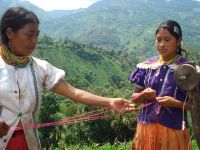
Guatemala: Native People Suffer Racism in Employment by Danilo Valladares


Guatemala City - 'There's a big difference in the way indigenous people and mestizos (people of mixed ancestry) are treated. We are not paid the same wages for the same work,' Higinio Pu, an activist with the native group Waxaquib Noj, which means 'wisdom' in the Maya Quiché language, told IPS.

'When workers are hired we are also passed over. And indigenous women who work in the 'maquilas' (plants assembling goods for export) are hit especially hard by discrimination,' said Pu.

These views were corroborated by a survey on 'Racismo y discriminación racial en el sector empresarial' (Racism and racial discrimination in the business sector), carried out in November by the Association for Research and Social Studies (ASIES), an NGO, and the Presidential Commission on Discrimination and Racism Against Indigenous Peoples in Guatemala (CODISRA).

Based on telephone interviews with 550 business owners in greater Guatemala City, the survey found that on average, only 12 percent of workers in small and micro-enterprises are indigenous people, while the workforce of medium and large businesses is made up of 20 percent native people.

According to official statistics, indigenous people comprise close to 40 percent of Guatemala's population of 14 million, but native organisations put the figure at over 60 percent.

Over half the business owners interviewed (52 percent) said they do not pay mestizos and indigenous people the same wages for the same work, and in some service sectors like retail the proportion of those admitting that they paid different wages was as high as 56 percent.

Pu agreed with the survey findings, but had considerably more to add.

'The survey did not collect information about the working conditions endured by indigenous people, which are often inhumane. During the coffee or sugarcane harvests, for example, the workers live in rough shacks or sheds and sleep all packed together on the floor,' he said.

Bequer Chocooj, the CODISRA commissioner, told IPS the survey 'is an initial approximation' to assessing employer discrimination against indigenous people, and has produced 'very valuable' results.

'The fact that 52 percent of business owners responded that there is a difference between the wages paid to indigenous persons and to mestizos for the same work confirms the 2010 National Employment Survey results, according to which indigenous workers earn 50 percent less than non-indigenous employees,' he said.

He also pointed out that the participation of indigenous employees in the Guatemalan business sector is 'very low.'

'Although 83 percent of the business owners surveyed said they have no preference between hiring indigenous or non-indigenous workers, the results show otherwise, because only between 12 and 20 percent of their employees are indigenous,' he said.

The consequences of this sort of labour discrimination for the Guatemalan economy are enormous, according to Chocooj.

'The economic cost to the country of ethno-racial discrimination in 2003 was over 6.3 billion quetzals (about 812 million dollars), equivalent to 3.3 percent of GDP' according to the 2009 study 'Diagnóstico del Racismo en Guatemala' (Analysis of Racism in Guatemala) carried out by the Vice Presidency of the Republic, he said.

'Without equality, we cannot develop. There is a historical debt owed to indigenous peoples that has to be redressed, by improving our access to political power and increasing public investment in health, education, basic services and productive projects,' said Chocooj.

The 2010 National Survey of Employment and Income carried out by the state National Institute of Statistics published data about the different level of participation in the economy of the indigenous compared to the non-indigenous population of Guatemala.

There are 3.4 million non-indigenous people in the labour force, compared with only 2.2 million indigenous people. And 44 percent of the country's underemployed people are indigenous, according to the 2010 survey.

Half the Guatemalan population lives below the poverty line, while 17 percent are extremely poor, most of them indigenous people, according to international bodies.

Chocooj is hopeful that the incoming government of president-elect Otto Pérez Molina, a retired general due to take office in January for four years, will create more opportunities for the development of indigenous communities.

This would require enlarging the budget of government institutions like the Ombudsman's Office for Indigenous Women, the Guatemalan Fund for Indigenous Development, and the CODISRA commission Chocooj presides, he said.

Ruben Narciso of ASIES, the social research association, told IPS that the survey they carried out with CODISRA clearly demonstrated that there is ethnic discrimination in the country when it comes to hiring workers.

'The goal of the survey on racism among business owners was to gather primary information as a basis for further studies on indigenous issues in relation to companies, and create public policies to counteract discrimination,' he said.

That is why they will shortly be holding meetings with private sector organisations to present the results of the survey and initiate discussions with a view to improving equality in the Guatemalan labour sector.

Anti-Wall Street Protesters Make a Show at Rose Parade By Hillel Aron


Pasadena – Hundreds of anti-Wall Street protesters sought to upstage the 123rd Tournament of Roses parade on Monday but were largely confined to the sidelines.

Several hundred protesters marched in a "human float" that followed behind the official parade, unfurling a 250-foot banner of the constitution and also displayed an approximately 70-foot octopus made of recycled plastic grocery bags.

"Everything is not coming up roses," one protester's sign said. Another read, "This is what democracy looks like."

Onlookers were allowed to walk along the parade route behind the official floats, so the protesters were joined by thousands of spectators and even a handful of counter-protesters, one of whom admonished the protesters to "get a job" on his megaphone.

The iconic Tournament of Roses parade, which was first held on New Year's Day in 1890, is broadcast on several U.S. television networks and in dozens of countries around the world.
The protesters' attempts to gain national attention were largely thwarted by television networks, which gave little attention to their efforts.

Anti-war activist Cindy Sheehan, whose son was killed during the Iraq war, joined the march and told supporters: "I haven't paid my income tax since my son was killed. I refuse to be a funder for their crimes against humanity."

Police estimated that roughly 300 to 400 protesters followed the parade route.

"They did exactly what they said they were going to do," said Pasadena Police spokeswoman Lt. Phlunte Riddle, who added that no arrests were made during the parade.

Three activists who were seated along parade the route did manage to unfurl a banner that read "Stop Foreclosures" across from the television news cameras when a Wells Fargo-sponsored carriage passed by before police quickly took it down.

"We wanted to send a message to Wells Fargo and every other bank," said Joshua Taylor, one of the three protesters.

Some protesters who marched behind the parade were wearing tents in a nod to the movement's origins, which was launched in New York in September and quickly saw tent cities spring up in major cities across the country to protest against economic inequality, corporate excesses, high unemployment and bailouts of major banks.

Protesters have since embraced a range of other causes, and in some cities the demonstrations have also focused on grievances about excessive police use of force.