Script

Only with your donations am I able to continue this blog. Please
consider donating.
Showing posts with label Brussels. Show all posts

Wednesday, March 21, 2012

Norway Leads Calls for EU Ban on Fish Discards

By Fiona Harvey

Norway - Giving up the wasteful practice of discarding edible fish at sea is not only possible, but can result in greater profits for fishermen, according to the fisheries minister in Norway, which has banned the practice.

Up to two-thirds of the fish caught in some European waters are thrown back dead because of the way the EU's common fisheries policy works. Proposals to end the waste have faced opposition from fishing groups and some EU member states, several of which attempted to scupper the ban at a meeting in Brussels on Monday. In the end, the attempt to block a ban on discards did not materialise, in part because of strong opposition from the public and high-profile campaigns such as FishFight initiative spearheaded by the TV chef Hugh Fearnley-Whittingstall. But the issue will be discussed by European legislators several times this year before going to a final vote.

It is 25 years since Norway introduced a ban on discards amid the steady decline of the Arctic cod. As a result, stocks of the species have recovered.

The experiences of Norway, which is outside the EU, should be taken as an example to member states, says the country's fisheries minister. Lisbeth Berg-Hansen. She told the Guardian: "I hope the rest of Europe will see this ban can be possible. Fishermen saw it as difficult at first but they have seen the quick results of this ban – the quota got bigger year by year."

Some fishermen, mainly in companies with industrial-scale vessels, want to keep the present discards arrangement because they can maximise their profits by throwing back lower value, though edible, fish.

Berg-Hansen said Norway's discards ban was introduced as part of a package of measures that meant fishermen saw other benefits, and shared in the bigger catches that were allowed as the species recovered. "We looked at the problem as a whole, took scientific advice and used several different methods," she added.

Technology was used extensively: selective gear meant smaller fish slipped through the net, preventing juveniles being caught and helping to avoid by-catch. Some fishing grounds were also closed temporarily to allow stocks to recover, particularly in areas where there was a high proportion of young fish.

The amount of allowable by-catch was also curtailed, with rules brought in which meant that fishermen netting a large amount had to change location to avoid breaking the law. Fishing was more closely monitored, and the value of any fish caught in contravention of the regulations was made forfeit to the state.

One key part of the plan, said Berg-Hansen, was public backing of the ban – there was a growing outcry in Norway over the huge quantities of cod being discarded, particularly at a time when stocks were dwindling. "People saw that discarding fish is an absolute waste and irresponsible resource management," she said.

Tuesday, March 13, 2012

Don't Believe Bankers' Warnings About a Robin Hood Tax

By Avinash Persaud

London - In Merchants of Doubt, the scientific historian Naomi Oreskes describes how a group of high-level scientists, with deep connections in politics and the tobacco industry, ran effective campaigns to mislead the public and deny well-established scientific knowledge on the link between tobacco and cancer. The same tactics are being used by London bankers today with regards to the proposal for a financial transaction tax (FTT), or Robin Hood tax. It is not the activity of bashing bankers that draws me to this debate, but the deliberate obfuscation by the industry. Doubt is their product, as a tobacco executive once said.

We know the UK government is opposed to the idea, and yet as finance ministers meet in Brussels to iron out the details of the 0.1%-0.01% tax on transactions that could raise as much as £48bn a year (£8.4bn in the case of the UK), nine of Europe's economies are in support.

Listening to some London bankers, you would think that a 0.1% tax would usher in a nuclear winter. Bankers are effectively saying that, while they justify their high pay with claims of superior creativity, credibility and connectivity, all of that cannot compete with a tax on each transaction of just one tenth of one per cent. If, despite the industry receiving billions in implicit public subsidies and guarantees, the largest sector in the UK economy hangs by such a thin thread, its value-added must be seriously questioned.

After hearing some of the bankers' responses, you would be forgiven for thinking that transaction taxes are a peculiar poison, but the economic and market impact of such taxes is no different than any other transaction cost (such as trading commissions; dealer spreads; fees for clearing, settlement, using exchanges; administration costs and the price impact of trading). This poses two problems to the nuclear-winter argument. First, just 10 years ago, these costs were collectively greater than they are today in the equity markets by the amount of the proposed tax, yet the sky did not fall on our heads. Indeed, and not unrelated, markets were a little more robust then than they are now. Second, the US is the largest and most efficient market in the world, yet a few years ago Professor Kenneth French documented that fees and charges by banks and funds on trading activities amounted to $100bn in the US, or 0.67% of the value of portfolios. By the nuclear-winter logic, this would hit investment, jobs and the wider economy far harder than a 0.1% transaction tax.

There are benefits to the services provided by dealers and fund managers for which they charge a fee, but if we are including benefits, then we must also consider the potential benefits of the use of FTT revenues. In the UK, it would likely raise £8.4bn that could reduce corporation tax by five percentage points to 19%, which would be the lowest in the world's rich countries bar Ireland, or eliminate all of the planned cuts to public education or double aid to the poorest.

It is interesting to note that the impact on the cost of capital of the alleged manipulation by some bankers of the British Bankers Association's Libor reference rates, on which $375tn of transactions are priced every day, was for many months greater than the impact on the cost of capital of a 0.1% tax on transactions in the secondary markets. But none of this will be equated and the heavyweights will be brought in to brush it all off with soothing platitudes: "These things happen" and "Isn't it good that this is now being put right?". In their foaming zeal to come up with examples of complicated off-balance sheet transactions that could potentially evade this tax, some bankers appear to have forgotten they are a regulated activity, and that today supervisors will require capital to be put aside for activities that seek to hide exposures, risks and clients.

Amid the obsfucation, we must take a broader perspective. Financial crashes are not random events – they almost always follow booms, and the bigger the boom the bigger the fall. One of the lessons of the last boom-bust cycle is that while low transaction costs are generally good, it is bad for the wider economy if they are so small as to be of no hindrance to financial activities that, through rapid turnover, give the impression of gleaming citadels of value when markets are rising, propelling the boom, but turn out to be nothing more than mirages when the boom busts, deepening the crash.

A little sand in the wheel of finance will help to smash the mirages that lure our economies in the wrong direction to the detriment of all. Taking this into account, a small transaction tax would be good for growth – helping to boost investment and jobs. Fast finance, like fast food, does not deliver sustainability.

Tuesday, March 6, 2012

France to Restore GMO Maize Ban Within Days: Ministry


France - France will reinstate a ban on the cultivation of Monsanto's MON810 maize (corn) in the next few days, in time to prevent the genetically modified grain being sown this year, an official at the farm ministry said on Tuesday.

Paris banned MON810 maize in 2008, citing environmental risks. The decision was overturned by the country's highest court in November on the basis that it was not sufficiently justified, leading the government to say it would look at all ways to maintain the freeze.

France, which will face a presidential election next month and where public opinion is fiercely opposed to genetically modified organisms (GMO), asked the European Commission last month to suspend the authorization to sow the maize, the only GMO crop allowed for cultivation in the European Union.

The ministry will publish a safety clause banning the growing of MON810 maize based on evidence sent to the EU executive and on any new evidence coming out of a public consultation it launched after sending its request to Brussels, the official said.

"A safety clause will be taken in the coming days on the basis of what was given to the Commission and the return of the public consultation," the official told Reuters.

The source declined to say whether comments submitted during the consultation, which closes on Tuesday evening, contained new evidence the ministry could use to back its upcoming decision to ban cultivation of the insect-resistant MON810 maize.

The French government's request to the EU Commission was based on "significant risks for the environment" shown in recent scientific studies, mainly one by the European Food Safety Agency (EFSA) in December on "bt11" GMO maize which said its conclusions also apply in some respects to the MON810.

Global seeds giant Monsanto, which says its GMO maize is perfectly safe, said in January it would not sell MON810 in France in 2012 and beyond.

Tuesday, February 28, 2012

Google's New Privacy Policy May Violate EU Rules


oogle's new privacy policy appears to violate the European Union's data protection rules, France's regulator said Tuesday, just two days before the new guidelines are set to come into force.
Google announced its new privacy policy with much fanfare last month. The rules, which are set to come into force on Thursday, regulate how the Web giant uses the enormous amounts of personal data its collects through its search engine, email and other services.

However, the EU's data protection authorities are concerned about the privacy effects of the policy and earlier this month asked French regulator CNIL to investigate them.

"Our preliminary analysis shows that Google's new policy does not meet the requirements of the European Directive on Data Protection," CNIL said in a letter to Google Chief Executive Larry Page. The letter was sent Monday and posted on CNIL's website Tuesday.

The agency said Google's explanation of how it will use the data was too vague and difficult to understand "even for trained privacy professionals."

The new policy makes it easier for Google to combine the data of one person using different services such as the search engine, YouTube or Gmail if he is logged into his Google account. That allows Google to create a broader profile of that user and target advertising based on that person's interests and search history more accurately. Advertising is the main way Google makes its money.

However, CNIL said data protection authorities in the EU "are deeply concerned about the combination of personal data across services," adding they had "strong doubts about the lawfulness and fairness of such processing."

Vivian Reding, the EU's Justice Commissioner who oversees the bloc's data protection rules, said she welcomed CNIL's letter and called on Google to delay its new policy.

Google argues that combining the data into one profile makes search results more relevant and allows a user to cross-navigate between different services more easily. It says the main purpose of the new policy is to combine the more than 70 different rules for Google's wide-ranging services into one that is simpler and more readable.

"We are confident that our new simple, clear and transparent privacy policy respects all European data protection laws and principles," Peter Fleischer, Google's global privacy counsel, wrote in response to CNIL's original letter, adding that users had more than a month to get familiar with the new rules.
Fleischer also rejected CNIL's reiterated request to delay the rollout of the privacy policy until all concerns have been cleared up.

"We have notified over 350 million authenticated Google users and provided highly visible notifications on our home page and in search results for our non-authenticated users," he wrote. "To pause now would cause a great deal of confusion for users."

The probe of the privacy policy is one of several battle lines between Google and the European Commission, the executive arms of the 27-country EU.

Google's search engine has a market share of more than 90 percent in the EU, with rival services like Microsoft's Bing gaining little traction.

The Commission is already examining whether Google uses this dominance to stop other search engines from entering the market. It is also investigating complaints from Microsoft and Apple into whether Motorola, which Google is in the process of taking over, is breaking EU competition rules in its aggressive enforcement of standard-essential patents.

Saturday, February 4, 2012

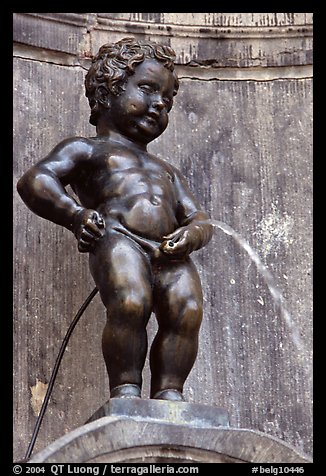
Odd Stories: Big Freeze Stops Famed Brussels Statue from Peeing


Brussels - The Manneken-Pis, a bronze statue of a young boy urinating that is a symbol of Brussels and a major tourist attraction, has had to stop peeing because of sub-zero temperatures, Belgium's tourist office said February 1st.

Officials turned off the flow of water through the statue, which has stood on a Brussels corner since the 1600s, out of concern the cold might damage its internal mechanism.

Temperatures in the Belgian capital were set to fall to minus 10 Celsius (14 degrees Fahrenheit) during the night, far below the average minimum for February.

"It all depends on the weather, if the temperatures go up again it will work again," a tourist office spokeswoman said.

The statue, which is on the site of a 15th Century drinking fountain, has more than 800 specially made outfits which city officials use to dress it up during the year. It is one of Brussels' most popular attractions.