Script

Only with your donations am I able to continue this blog. Please
consider donating.
Showing posts with label Nature Magazine. Show all posts

Thursday, March 1, 2012

Dinosaurs Had Fleas Too - Giant Ones, Fossils Show


In the Jurassic era, even the flea was a beast, compared to its minuscule modern descendants. These pesky bloodsuckers were nearly an inch long.

New fossils found in China are evidence of the oldest fleas — from 125 million to 165 million years ago, said Diying Huang of the Nanjing Institute of Geology and Paleontology. Their disproportionately long proboscis, or straw-like mouth, had sharp weapon-like serrated edges that helped them bite and feed from their super-sized hosts, he and other researchers reported Wednesday in the journal Nature.

Scientists figure about eight or more of today's fleas would fit on the burly back of their ancient ancestor.

"That's a beast," said study co-author Michael Engel, entomology curator at the Natural History Museum at the University of Kansas. "It was a big critter. I can't even imagine coming home and finding my miniature schnauzer with one or more of these things crawling around on it."

The ancient female fleas were close to twice the size of the males, researchers found, which fits with modern fleas.

But Engel said it's not just the size that was impressive about the nine flea fossils. It was their fearsome beak capable of sticking into and sucking blood from the hides of certain dinosaurs, probably those that had feathers.

These flea beaks "had almost like a saw running down the side," Engel said. "This thing was packing a weapon. They were equipped to dig into something."

While the ancient fleas were big, they had one disadvantage compared to modern ones: Their legs weren't too developed. Evolving over time, fleas went from crawling to jumping, Huang said.

"Luckily for the land animals of the Mesozoic, these big flat fleas lacked the tremendous jumping capacity that our common fleas have," said Joe Hannibal of the Cleveland Museum of Natural History. He wasn't involved in the study, but praised it as useful and interesting.

Just finding the fleas was a stroke of luck, Huang said. He first found one in a Chinese fossil market and mentioned it to someone at his hotel. The other guest showed him a photo of another fossilized flea, telling him it was from Daohugou in northeastern China, where there's a famous fossil bed from about 165 million years ago. Huang went there and found fleas preserved in a brownish film of volcanic ash. The grains of rock were so fine you could see antennae and other details of the fleas, he said.

Modern fleas get engorged after they feast on blood, but these didn't seem engorged, Engel said.

It shouldn't seem too surprising that there were large fleas more than 100 million years ago. If you go back even farther in time, ancestors of dragonflies and damsel flies had 3-foot wingspans, Engel said.

Monday, January 16, 2012

Get Tough on Nuclear Safety

Originally posted by Nature Magazine

A refreshingly frank and forward-looking report on the safety of French nuclear power plants in the wake of Fukushima should spur other countries to take a hard look at regulation of their own reactors.

The Three Mile Island and Chernobyl nuclear accidents each prompted profound rethinks of safety requirements. But as the incidents slipped into history, the nuclear industry, regulators and governments tended to revert to reassuring refrains that atomic energy was once again safe and in expert hands.

So it is probably too early to be confident about the impact of the Fukushima accident in Japan last March. But it is clear that, as the defences at the Fukushima Daiichi power plant crumbled, so too did the fundamental dogma of modern nuclear safety: that a series of back-up and redundant safety systems, combined with physical defences strong enough to resist expert estimates of external threats, was enough to make impossible a catastrophic meltdown and release of radioactivity into the environment.

As the first anniversary of the disaster approaches, and supporters and opponents of nuclear power prepare to use it to underscore their positions, will Fukushima mark a turning point for the nuclear enterprise, or will industry return to business as usual?

André-Claude Lacoste, head of France's Nuclear Safety Authority (ASN) in Paris, suggested at a press conference last week that things have already changed. “There will be a before and an after Fukushima,” he promised.

Is he right? Some in industry will always oppose the costs of tougher regulation, and shortsighted or ideological politicians and companies will continue to insist that a repeat of Fukushima is impossible in their own backyards. But many in the nuclear industry were genuinely and deeply shocked to see at Fukushima a sequence of events that they believed impossible. The world's main nuclear operators have an interest in establishing the causes of the disaster and learning the lessons — they know too well that if another major accident were to occur, then in many people's eyes the already-struggling industry would be finished.
The World Association of Nuclear Operators, for example, has stressed the need for its members to respond properly to Fukushima, and has beefed up its own inspection and oversight of plants (see Nature 472, 274 and http://doi.org/hj5; 2011).

So to France, the world's leading user of nuclear power and arguably the nation with the most to lose from a global rejection of it. Last week, the ASN released a report announcing a sweeping safety upgrade to all the country's reactors (see page 121). The planned multi-billion-euro improvements are part of a programme of tests to assess how well French reactors would stand up to extreme events, and how prepared plants are to deal with a major accident. The ASN's report is written with stunning candour, stating plainly that a loss of coolant or electricity could, in the worst cases, see meltdowns at reactors in hours. It also lists many shortcomings found during 'stress tests', in which some safety aspects of plants were found not to conform to existing standards.

Critics will wonder why the ASN didn't spot these problems earlier, given that it is responsible for regulating the plants. Others will question how the authority can reconcile its statement that France's reactors are fundamentally safe with its insistence that they must be upgraded on safety grounds. But it would be a mistake to penalize France for listing its nuclear shortcomings, especially when other nations seem less enthusiastic about publicly discussing problems with their own reactors and regulations. The French report makes for a breath of fresh air in a post-Fukushima climate in which worldwide public reassurance has too often taken priority over transparent debate.

The ASN has also come up with an elegant technical solution to get around the (universal) dilemma of how to protect a plant from external threats, such as natural disasters. The report recommends that all reactors, irrespective of their perceived vulnerability, should add a 'hard core' layer of safety systems, with control rooms, generators and pumps housed in bunkers able to withstand physical threats far beyond those that the plants themselves are designed to resist.

There will, rightly, be scepticism about whether France will ultimately implement the new measures. The bunker concept may prove technically difficult, and Électricité de France — the operator of the reactors — would need to pay for systems that some in the company will probably feel are an expensive luxury.
Whatever happens in the long term, the French plans have an immediate benefit: they raise the post-Fukushima safety bar for other countries. Those governments, regulators and companies that have yet to propose anything close to such far-reaching measures must now explain why not.

Friday, January 6, 2012

Now You See It, Now You Don't: Time Cloak Created


— It's one thing to make an object invisible, like Harry Potter's mythical cloak. But scientists have made an entire event impossible to see. They have invented a time masker.

Think of it as an art heist that takes place before your eyes and surveillance cameras. You don't see the thief strolling into the museum, taking the painting down or walking away, but he did. It's not just that the thief is invisible — his whole activity is.

What scientists at Cornell University did was on a much smaller scale, both in terms of events and time. It happened so quickly that it's not even a blink of an eye. Their time cloak lasts an incredibly tiny fraction of a fraction of a second. They hid an event for 40 trillionths of a second, according to a study appearing in Thursday's edition of the journal Nature.

We see events happening as light from them reaches our eyes. Usually it's a continuous flow of light. In the new research, however, scientists were able to interrupt that flow for just an instant.

Other newly created invisibility cloaks fashioned by scientists move the light beams away in the traditional three dimensions. The Cornell team alters not where the light flows but how fast it moves, changing in the dimension of time, not space.

They tinkered with the speed of beams of light in a way that would make it appear to surveillance cameras or laser security beams that an event, such as an art heist, isn't happening.

Another way to think of it is as if scientists edited or erased a split second of history. It's as if you are watching a movie with a scene inserted that you don't see or notice. It's there in the movie, but it's not something you saw, said study co-author Moti Fridman, a physics researcher at Cornell.

The scientists created a lens of not just light, but time. Their method splits light, speeding up one part of light and slowing down another. It creates a gap and that gap is where an event is masked.

"You kind of create a hole in time where an event takes place," said study co-author Alexander Gaeta, director of Cornell's School of Applied and Engineering Physics. "You just don't know that anything ever happened."

This is all happening in beams of light that move too fast for the human eye to see. Using fiber optics, the hole in time is created as light moves along inside a fiber much thinner than a human hair. The scientists shoot the beam of light out, and then with other beams, they create a time lens that splits the light into two different speed beams that create the effect of invisibility by being too fast or too slow. The whole work is a mess of fibers on a long table and almost looks like a pile of spaghetti, Fridman said.

It is the first time that scientists have been able to mask an event in time, a concept only first theorized by Martin McCall, a professor of theoretical optics at Imperial College in London. Gaeta, Fridman and others at Cornell, who had already been working on time lenses, decided to see if they could do what McCall envisioned.

It only took a few months, a blink of an eye in scientific research time.

"It is significant because it opens up a whole new realm to ideas involving invisibility," McCall said.

Researchers at Duke University and in Germany's Karlsruhe Institute of Technology have made progress on making an object appear invisible spatially. The earlier invisibility cloak work bent light around an object in three dimensions.

Between those two approaches, the idea of invisibility will work its way into useful technology, predicts McCall, who wasn't part of either team.

The science is legitimate, but it's still only a fraction of a second, added City College of New York physicist Michio Kaku, who specializes in the physics of science fiction.

"That's not enough time to wander around Hogwarts," Kaku wrote in an email. "The next step therefore will be to increase this time interval, perhaps to a millionth of a second. So we see that there's a long way to go before we have true invisibility as seen in science fiction."

Gaeta said he thinks he can get make the cloak last a millionth of a second or maybe even a thousandth of a second. But McCall said the mathematics dictate that it would take too big a machine — about 18,600 miles long — to make the cloak last a full second.

"You have to start somewhere and this is a proof of concept," Gaeta said.

Still, there are practical applications, Gaeta and Fridman said. This is a way of adding a packet of information to high-speed data unseen without interrupting the flow of information. But that may not be a good thing if used for computer viruses, Fridman conceded.
There may be good uses of this technology, Gaeta said, but "for some reason people are more interested in the more illicit applications."

Tuesday, December 20, 2011

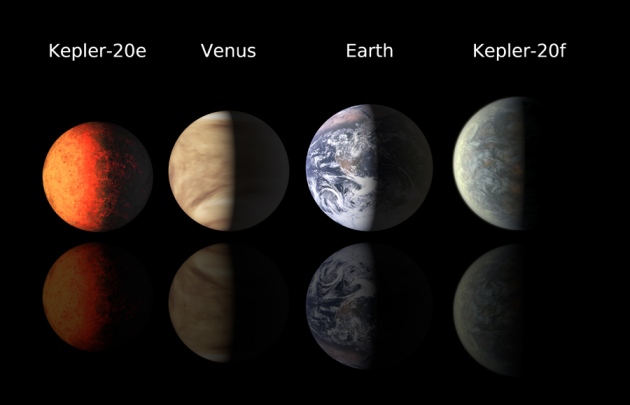
Kepler Telescope Finds Two Earth-sized Planets


New York – Two Earth-sized planets were discovered by scientists orbiting a star 950 light-years outside our solar system.

The news brings many things to light. One is planets from such a distance away are able to be detected by the Kepler spacecraft, NASA's telescope which currently found several dozens of Earth-sized planets. Another is the possibility of life being present on the planet. Third is the features of the planet. So far the planets, named Kepler-20e and Kepler-20f, possess a radius .87 times and 1.03 times our planet respectively. Both seem to be rocky and are the smallest of such planets orbiting a sun like ours found so far. Kepler-20e has a six Earth-day orbit, Kepler-20f orbits its star with a 20-day orbit. Nature magazine states neither of them are in what's called “the habitable zone,” nor do they spin on their axes. The scientists have yet to work out the planets' densities, which will be done with instruments like the HARPS-North radial-velocity spectrometer in the Canary Islands. It will be revealed around April of 2012

Despite this news however, presently humans would not be able to survive on either planet even if we were able to travel there in a relatively short period of time due to their temperatures. Kepler-20e is estimated to be 1,400 degrees Fahrenheit and 20f reaches 800.

This news comes on the heels of another planet found with a surface more friendly to us, roughly about 72 degrees Fahrenheit, but too large to suggest life exists on its surface. That planet is estimated to be 2.4 times the size of Earth and possibly more like Neptune than Earth.

“Kepler can do things that no other telescope can do,” says Jonathan Fortney, astronomer at the University of California, Santa Cruz. He states the fact the two planets are sandwiched between three larger planets spanning a size spectrum from “super-Earths” to “mini-Neptunes” makes them strange finds. David Charbonneau, a Harvard-Smithsonian Center astronomer and co-author of the paper, stated “Different-sized planets do not mingle in [our] solar system, but apparently in this system they do.”

Update: Astronomers believe the planets were once gas giants that were stripped down after being swallowed by their swollen, aging parent.  They also say they "are sure there is no life on these planets."