Script

Only with your donations am I able to continue this blog. Please
consider donating.
Showing posts with label New Jersey. Show all posts

Monday, March 5, 2012

States Slash Birth Control Subsidies as Federal Debate Rages


United States - Even as a national debate rages over contraception insurance, tens of thousands of low-income women and teenagers across the United States have lost access to subsidized birth control as states slash and restructure family planning funds.

Montana and New Jersey have eliminated altogether their state family planning programs. New Hampshire cut its funding by 57 percent and five other states made more modest program trims.

But the biggest impact, by far, has been in Texas.

State lawmakers last fall cut family-planning funds by two-thirds, or nearly $74 million over two years.

Within months, half the state-supported family planning clinics in Texas had closed.

The state network, which once provided 220,000 women a year free and low-cost birth control, cervical cancer tests and diabetes screenings, will now serve just 40,000 to 60,000, officials said.

Another 130,000 low-income Texas women who get free exams and contraceptives through Medicaid could lose those benefits by month's end, due to a dispute between the state and federal governments over whether Planned Parenthood should be allowed to serve women on that program.

At the People's Community Clinic in Austin, the cuts mean that many low-income patients, except the very poorest, are now charged for contraception that used to be free: $5 for a dozen condoms; $10 for a month of birth control pills; $225 for an IUD.

"I have no clue what I'm going to do," said Rhetta Pope, 22, of Austin. A stay-at-home mother of two, she lives off disability payments of less than $1,500 a month.
Pope said after paying basic living expenses, she has so little left she scrimps on electricity by keeping the lights off and takes her laundry to an aunt's house. She can't imagine how she would pay for birth control.

"I guess I'm going to have to stop using it because I don't have the money," Pope said. "I'm pretty shook up. I really am."

SAVINGS IN DOUBT

Texas legislators who backed the 66-percent family planning cuts say they had no choice - the state budget was in crisis and many worthy programs suffered.

But a budget board analysis concluded the cut would actually cost Texas taxpayers more than it saved.

The board projected that women unable to get low-cost birth control would deliver 20,500 additional babies - costing state and federal taxpayers $231 million in prenatal, maternity and infant care. The state's share would be close to $98 million - significantly more than the family planning cut savings.

State Representative Wayne Christian, a Republican, acknowledged that the cuts might be counterproductive "if you look at it from a financial cost, perhaps."

But he disputed the notion that additional babies were a cost burden. "We value a human life more than just the cost," he said.

In general, he said, the state should not try to deter births by widely distributing free contraception. If women who want birth control cannot afford it, he said, they should first seek help from families or communities.

"I'm sorry," Christian said, "but there's this thing called individual responsibility."

Some women have found ways to pay for the care they once received free, but many have not.
After losing much of its state family-planning grant, the Parkland Health & Hospital System in Dallas in January began charging most patients a flat $25-per-visit fee.

In the first two weeks of the policy, 362 women cancelled appointments because they could not make the co-pay. Only 20 percent found the money to get care within a week or two, hospital officials said.

Another 20 percent were referred to one of the two Parkland locations still providing free services. Those sites are now so busy, the first available appointment at the Irving Women's Health Center is August 21.

Most of the remaining women never came back for care after learning about the co-pay, said Paula Turicchi, a Parkland senior vice president.

BLOCKING TAXPAYER DOLLARS

In several states, including Texas, questions about birth control access are now entangled with the politically explosive abortion debate.

Planned Parenthood is the nation's largest abortion provider, with about 330,000 procedures a year. It also runs a network of urban and suburban clinics offering birth control, gynecological exams and care for sexually transmitted diseases.

The organization gets about a third of its revenue, $360 million in 2009, from government grants to provide those services to poor women.

In the past year, Wisconsin, North Carolina, Tennessee, Indiana and Texas all have moved to block Planned Parenthood from receiving taxpayer money. Several other states, including Ohio, Oklahoma and New Hampshire, are considering similar moves.

While public funds don't pay for abortions, critics of Planned Parenthood argue that hiring the organization to provide family planning to poor women helps the organization stay afloat and thus indirectly supports abortion services.

The Texas funding cut prompted Planned Parenthood to shut down 11 clinics. It also has jeopardized a $40 million family-planning program run as a Medicaid extension.

The program provides free birth control and annual exams to 130,000 low-income women of reproductive age who don't qualify for regular Medicaid. The federal government pays 90 percent of the cost; Texas puts up just $4 million a year.

About 40 percent of women in the Texas program get subsidized care from Planned Parenthood clinics, but a new state law blocks those clinics from participating. The Obama administration has said that violates federal Medicaid rules. If neither side compromises, the program will likely close by the end of March.

That infuriates Jonee Longoria, a single mother in Houston who relied on the program for free services for several years as she put herself through college. "I had one child living in poverty and I didn't want another," Longoria said.

She now works for a social service agency and refers many clients to the program for contraception. Without it, she said, "where would they go?"

Advocates of defunding Planned Parenthood say they regret any service disruptions for poor women. But they call it a necessary price to pay to take a moral stance on abortion.

"We're just doing what we think is best," said Joe Pojman, executive director of Texas Alliance for Life, which opposes abortion.

Tuesday, February 14, 2012

5,000 Homeless Americans Live in Tent Cities


By Noel Brinkerhoff
 
United States - While the U.S. unemployment rate has improved slightly in recent months, the rosy news of better times ahead contrasts with the difficult reality still haunting many Americans, especially for those living in tents to survive.
 
It is estimated that at least 5,000 individuals today call “tent cities” their home. These makeshift, and unhealthy, settlements have sprung up in more than 50 cities, including Portland, Oregon; Lakewood, New Jersey; Ann Arbor, Michigan; Pinellas Park, Florida; and Bakersfield, California.
 
Some of the tent cities house a few dozen, while others provide shelter for as many as 300. Many are supported by local churches while others face eviction because of safety code violations.
 
The conditions of the encampment in Ann Arbor have been described as “unhygienic." There are no toilets and electricity is only available in the one communal tent where the campers huddle around a wood stove for warmth in the heart of winter,” according to the BBC News.

Thursday, February 2, 2012

Sports Piracy Sites to See Increased Crackdowns

Newark, New Jersey - Hours after famed New England Patriots quarterback Tom Brady told reporters he watched the Super Bowl on a website that illegally streamed the event, federal authorities said they will crack down on websites which will stream the sports show this year.

Sixteen sites, of which nine were owned by a man in Michigan, were taken down in what's called "Operation Fake Sweep"and the owners are facing charges.  The man, Yonjo Quiroa, is facing charges of copyright infringement and is being held without bail.  He streamed football, basketball, hockey, and wrestling events according to prosecutors.

In a press release U.S. Attorney Preet Bharara told sports fans watching the event on pirate sites raises the costs of tickets and harms broadcasters, sports leagues, and hurts other customers overall.  However investigators are not just going after websites that do this.

In Indianapolis, federal authorities also seized almost five-million dollars worth of sportswear and merchandise after what they say was a four-month long investigation.  Stores, flea markets, and street vendors were also targeted by U.S. Immigration and Customs Enforcement, better known as ICE

Friday, January 20, 2012

Pro Golfer, Swim Coach Among 40 Busted in Sex Sting Operation

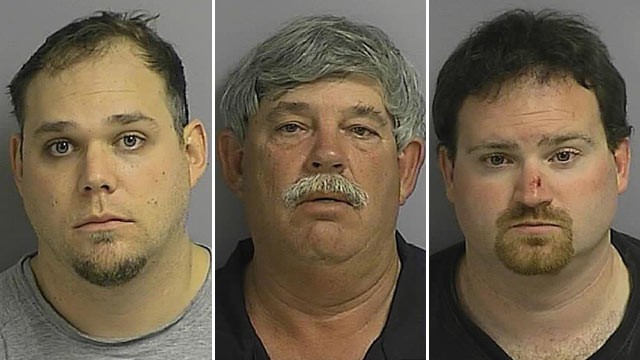
PHOTO: (l-r) Roy Alexander, Stephen Wesley Thomas and Bryan Allen Woodward are among the 40 arrested in underage sex sting operation.

Orlando - From January 8th to the 16th of this year Osceola County Sheriffs Department (OCSD) conducted sex sting operations in several counties in Florida.

Known as Operation Red Cheeks, detectives and investigators set-up online profiles as either minors or as a 30-year-old mother with a 13-year-old daughter, all of whom were interested in having sex.  Through internet chatrooms, the investigation led to 40 arrests including the three pictured men.

Alexander Roy (left), is an eighth-grade math teacher at the Manatee Academy who traveled from Port St. Lucie to Kissimmee to have sex with a mother and her 13-year-old daughter.

PGA professional golfer Stephen Wesley Thomas (center), believed he was chatting with a mother about possibly having sex with her and her 13-year-old daughter as well. The 'mother' was only willing to have sex with Thomas if she could watch him perform sex acts on and with her daughter. When arrested and searched, Thomas was found to have condoms, chocolate pudding, and honey. Thomas has since posted bail.
Bryan Allen Woodard (right), a private swim team coach who coached 200 children, mostly under the age of 18, was arrested for chatting with a '14-year-old' whom he agreed to meet. The Gator Swim Club coach was found in possession of M&M's and aside from discussing graphic sexual acts reportedly told the undercover cop, "younger girls turn me on."

"What is most concerning about this is not that there are so many people out there, but that some of these people work directly with children," said Twis Lizasuain, a spokeswoman for the OCSD.

Ranging in ages from 18-70, most of the suspects came from the central Florida area. Men from Georgia, Alaska, New York, and New Jersey were also caught in separate stings.

Nine students, including one in high school and a student at the Golf Academy of America were also arrested and charged.

Some suspects responded to fake advertisements like "2 for 1 girls on vacation" or "Fun family intimate experience" on the Internet and in most cases the suspects sent inappropriate photos to who they believed was a minor.

Hidden surveillance cameras, internet chat logs, and other evidence were collected in each case and all suspects are charged with an array of offences ranging from traveling to seduce a child to commit a sex act, use of a computer to induce a guardian to facilitate sex with a child, and attempted lewd and lascivious battery.


Friday, January 13, 2012

Study Shows Doctors Over-treat Urine Bacteria


Reuters Health - In a new study of patients with bacteria in their urine, doctors prescribed antibiotics to one in three who had no symptoms and no evidence of a urinary tract infection.

In those cases, the bacteria probably would have disappeared on their own without causing any problems, researchers said, and treating those patients with drugs goes against guidelines -- because it increases the risk of antibiotic resistance without any real benefit.

"When the average physician sees a positive (for bacteria) urine culture, they automatically think of treating," said Dr. Peter Gross, an infectious diseases specialist at Hackensack University Medical Center in New Jersey who was not involved in the new study.

Gross told Reuters Health that many doctors are afraid of the consequences -- such as getting sued -- if they decide not to treat bacteria in the urine and it does develop into something more serious. Others, he added, might equate a positive test for bacteria with a urinary tract infection, or UTI, without thinking about other options.

In the new study, researchers from the Houston, Texas, Michael E. DeBakey Veterans Affairs Medical Center and the MD Anderson Cancer Center analyzed the medical records of patients at their hospitals whose urine had tested positive for a specific type of bacteria in late 2009.

That included 339 specific cases. Most patients were older and male, and being treated in the hospital or emergency room when their urine was tested.

Based on information from the lab tests and notes on patient symptoms characteristic of a UTI -- such as fever and pain while urinating -- the researchers determined that 156 patients had an infection, while 183 had cases of so-called colonization, with no sign of infection.

In patients with UTI symptoms, doctors were almost 12 times more likely to prescribe antibiotics as in symptom-free cases, Dr. Barbara Trautner, of the VA, and her colleagues reported in the Archives of Internal Medicine this week.

Still, 60 patients out of the 183 without evidence of a UTI were treated with antibiotics, against guidelines from the Infectious Diseases Society of America.

Only in specific cases, such as in pregnant women, do guidelines recommend treating bacterial colonization in symptom-free people using antibiotics.

Hospital patients who need a catheter are especially likely to develop bacteria in the urine. If it's not a full-on infection, Gross said, those patients will probably clear any bacteria within a week after getting the catheter taken out -- without the help of antibiotics.

Trautner's team found few side effects associated with the antibiotics used in patients with or without a UTI.
That doesn't change the fact, they note, that using antibiotics when they're not called for contributes to drug resistance -- when bacteria no longer respond to one or more types of antibiotics and infections get more difficult to treat.

What's more, the most commonly used antibiotics in all patients with bacteria in their urine were quinolones, which are known as "broad-spectrum" antibiotics. Those drugs work against the widest range of bacteria, which means that resistance is a bigger concern with their overuse.

Many hospitals already have efforts in place to limit the unnecessary use of antibiotics, but Gross said the decision of when to use drugs still often requires a fair amount of judgment on the part of doctors. So patients' knowledge of appropriate and inappropriate use matters too, he said.

"There's nothing like an educated patient," Gross said. "Patients need to know that not every positive urine culture indicates infection, it could just indicate colonization."

When it comes to using antibiotics, he said, "I agree with, 'less is more.'"

Monday, January 9, 2012

Early Talking Doll Recording Discovered


ScienceDaily (July 17, 2011) — On May 11, 2011, scientists at the Lawrence Berkeley National Laboratory in Berkeley, California recovered sound from an artifact that historians believe is the earliest surviving talking doll record. The artifact is a ring-shaped cylinder phonograph record made of solid metal, preserved by the National Park Service at Thomas Edison National Historical Park. Phonograph inventor Thomas Edison made the record during the fall or winter of 1888 in West Orange, New Jersey.
 
On the recording, an unidentified woman recites one verse of the nursery rhyme "Twinkle, twinkle, little star." The voice captured on the 123-year-old record had been unheard since Edison's lifetime. The recording represents a significant milestone in the early history of recorded sound technology.

Recovering and Identifying the Sound
The metal record is significantly bent out of its original round, cylindrical shape. For this reason, curators at Thomas Edison National Historical Park were unable to play the recording using conventional methods. At the Lawrence Berkeley National Laboratory, Senior Scientist Carl Haber and Computer Systems Engineer Earl Cornell used a three-dimensional optical scanning technology developed during 2007-2009, in collaboration with the Library of Congress, to create a digital model of the surface of the record. With this digital model, they used modern image analysis methods to reproduce the audio stored on the record, saving it as a WAV-format digital audio file. They were able to recover all but the first syllable of the first word of the recording. Once the recording could be heard, historian Patrick Feaster of Indiana University played a key role in identifying and dating the recording by finding relevant references among archival documents. Researcher René Rondeau of Corte Madera, California provided additional fact-checking assistance.

Talking Doll Records Made of Tin
In search of a market for his invention the phonograph, Edison first attempted to make talking dolls during 1888. The prototype model described in laboratory notes and newspaper articles between September and December of that year was distinctive for using a record made of solid tin. In November 1888, the New York Evening Sun announced that Edison's talking dolls had just been "perfected," and that "nothing remains but to manufacture them in large quantities." No commercially viable method of duplicating sound recordings had yet been developed, so Edison hired women with suitable voices to make as many records as he thought would be needed once his talking dolls were put on the market: "There were two young ladies in the room...who were continually talking to the tiny speaking machines, which a skilled workman was turning out in great numbers."

Significance of the Recording
According to Feaster, this New York Evening Sun report marks the first time anyone is known to have been employed specifically to perform for the phonograph, so these women were arguably the world's first professional recording artists. If the goal was to stockpile these tin records "in large quantities" to supply the eventual demand for talking dolls, as the New York Evening Sun suggests, then they may also have been the first phonograph recordings ever manufactured for sale to the public, even though they were never actually sold.

It was more than a year later, in April 1890, when Edison placed a talking doll on the market. By that time, however, he had switched the design to use records made of wax rather than tin. The dolls failed to sell because they broke too easily -- due in part to the fragility of the records. It is unclear why Edison switched from tin to wax records for the talking doll.

Provenance of the Artifact
National Park Service museum curators first cataloged the object in 1967, found among items left in the desk of Edison's secretary William H. Meadowcroft, located in the library of the Edison Laboratory in West Orange, New Jersey. A paper tag found tied to the cylinder reads: "Tin Phonograph Cylinder […]l Record." The artifact is the only example of a talking doll record from 1888 known to survive today.

Update: I've been asked if I could upload the audio, so here it is.


Thursday, January 5, 2012

U.S. Twin Births Have Doubled in Three Decades: Study


By David Beasley

Atlanta - The number of twins born in the United States has doubled in the last three decades largely as a result of fertility treatments, with one in 30 infants born in 2009 a twin, the Centers for Disease Control and Prevention said on Wednesday.

"The increases are quite widespread, affecting all age groups and all parts of the country," said Joyce Martin, a CDC epidemiologist and coauthor of the new study.

More than 137,000 twins were born in the United States in 2009, accounting for one in every 30 babies. That compares to 68,339 twins born in 1980 when just one in 53 infants born was a twin, the CDC said.

A third of the increase in the twin birth rate can be attributed to women waiting longer to have children, the CDC said. From 2000 to 2009, more than 35 percent of all births were to mothers ages 30 and over, up from 20 percent in 1980.

The number of twins per 1,000 births rose in all 50 states and doubled in Connecticut, Hawaii, Massachusetts, New Jersey and Rhode Island.

Treatment for infertility such as in-vitro fertilization accounts for much of the remainder of the increase in twins, the CDC said.

"We seem to be making improvements, refinements to fertility-enhancing therapies, so that could then result in a lowering of the increase of the pace in twin and other multiple births," Martin told Reuters.
Twin births are riskier than single births, she said.

"Infants born in twin deliveries are at greater risk of poor outcome," she said. "They are born smaller, they are born earlier. They are more likely not to survive the first year. Most twins do fine, but they are at higher risk."

Tuesday, December 27, 2011

State Cuts to Medicaid Affect Patients, Providers


— Just as Medicaid prepares for a vast expansion under the federal health care overhaul, the 47-year-old entitlement program for the poor is under increasing pressure as deficit-burdened states chip away at benefits and cut payments to doctors.
Nearly every state has proposed or implemented a plan in its current budget to rein in costs, and many are considering additional cuts in the year ahead.

For the tens of millions of poor and disabled who rely on the program — approaching nearly one in five Americans — the cuts translate into longer waits for doctors, restrictions on prescription drugs, a halt to vision and dental care, staff cuts at nursing homes and dwindling access to home health care.

Ruth Wohlforth, 70, is among those feeling the effects.

Her $700 monthly income qualifies her for both Medicare and Medicaid, but she says her benefits have been reduced, she's being forced her to make co-pays for the first time on prescription drugs, and she now has to drive about 30 minutes from her home near the southern tip of New Jersey to see a doctor. Some of her friends have been assigned to doctors in Philadelphia. 

She said she feels lawmakers are not aware of the real-world consequences of their spending cuts.
"I've seen so many people in tears, and they don't know what to do," Wohlforth said. "People that are older than I am, and are in worse shape, they get befuddled by the whole thing. They don't know where to go for help; they just feel they're not being listened to."
States are reshaping the Medicaid landscape even as the need has grown along with joblessness during the recession.

The $427 billion-a-year program, a combination of state and federal funding, also had been targeted for additional cuts at the federal level this year as members of Congress sparred over how to reduce the nation's debt. But funding seems safe for now after a special committee failed last month to reach an agreement on how to cut overall spending.

Already, many changes at the state level have been dramatic and are testing the legal bounds of what Medicaid must provide:

— Arizona, for a time, eliminated life-saving transplants for Medicaid patients, and hospital officials in the state blame at least one death on the halt in coverage. Gov. Jan Brewer restored transplants but is prohibiting thousands of low-income, childless adults from entering the program and has added fees on those who smoke and the obese.

— New Jersey Gov. Chris Christie is pushing a plan under which only the poorest would qualify. A parent of two making more than $103 per week would no longer be eligible for coverage.

— The U.S. Supreme Court will decide whether California has the right to continue cutting payments to physicians and other Medicaid providers to help close the state's ongoing budget deficit.

Cuts to provider fees, as in California, have been the most frequently used tactic by states to save Medicaid costs. A recent survey by the National Association of State Budget Officers found that 33 states wanted to reduce provider rates and another 16 sought to freeze them.
California was granted permission by federal officials to make broad cuts to reimbursement rates to its Medicaid program, known as Medi-Cal, in October. The cuts include a 10 percent reduction to payments for outpatient services for doctors, clinics, optometrists, dental services, medical equipment and pharmacy. They are intended to save the state an estimated $623 million.

A coalition of trade associations representing doctors, pharmacists and chain drug stores has filed a lawsuit seeking to stop the cuts. Doctors who care for Medi-Cal patients say they already have been subjected to multiple pay cuts, and some say they no longer will be able to serve the state's neediest patients.

About 70 percent of Dr. Douglas Tolley's practice in Yuba County is covered by Medi-Cal. The 64-year-old obstetrician, who practices in a largely agricultural region about 40 minutes north of the state capital, said he is the old-school sort of doctor who "was brought up in a time when doctors took care of all comers."

Yet he has seen his income steadily drop over the last 18 years — down one-third from what it was when he started.

"Everybody understands that doctors are basically small business people, and we have to meet our cost plus make a living." Tolley said. "Just meeting our cost doesn't mean staying in business."

Even more state cuts could be on the horizon. In Maine, Gov. Paul LePage recently proposed removing 65,000 residents from the program, citing a state Medicaid shortfall estimated to reach $221 million through mid-2013. The Republican governor says he will not consider tax increases to make up the difference.

State officials, who are required to balance their budgets, argue they have no choice but to cut into Medicaid after four straight years of budget deficits. With state and federal funds combined, Medicaid makes up 22 percent of total state spending, the largest single portion of most state budgets, according to the National Association of State Budget Officers.

Critics say the moves are shortsighted.

Joan Alker, co-executive director of the Center for Children and Families at Georgetown University, said slashing Medicaid will not stop the sick from seeking care, sending them to emergency rooms and ultimately inflating private medical insurance premiums.
"At the end of the day, for the children, the individuals with disabilities, the seniors in nursing homes, their health care needs are not going to go away just because someone cuts the Medicaid program," Alker said.

Jerry Kemmer, a former Democratic state assemblyman in New York, said Medicaid has long been an issue lawmakers did not want to touch. Now, they simply have no choice.

"It's ballooned to the extent that it's just become a budget-buster," he said.

Six million people have joined the Medicaid rolls since the recession began in late 2007. Enrollment nationally topped 50 million for the first time in June 2010, a number that is projected to keep rising, especially as the nation's unemployment rate remains high.
Billions of dollars from the federal stimulus program helped avoid deep Medicaid cuts through the worst of the recession, but the last of that money dried up this year.

In Florida, Medicaid reimbursement rates were reduced this year by 12 percent for most hospitals, although rural and children's hospitals were cut just 3 percent, and rates for nursing homes were cut 6.5 percent.

But the start of the next legislative session in January already has some people worried about additional cuts.
Debra St. Fleur, 25, of Miami, is covered by Medicaid, along with her 1-year-old son. Many of her neighbors in the city's Little Haiti section are on Medicaid, too, and she worries what would happen if services continue to be eroded.

"It's really scary," she said. "If they can't get their medicine, what's going to happen? They're going to die."
The Obama administration is concerned enough about the widespread Medicaid provider cuts that it has introduced a rule that would make it harder for states to slash the rates. The move is designed to ensure that those eligible for Medicaid are not denied access due to a shortage of 
health care resources.

Medicaid reimbursement rates already trail those physicians receive for treating Medicare patients and those with private insurance. A study by the nonpartisan Center for Studying Health System Change found that on, average, Medicaid would reimburse a doctor $39 for 45 minutes for a new patient hospital visit, compared to $63 for Medicare.

Physician groups say that has left more and more doctors declining to see Medicaid clients. Some providers are trying to find other ways to make up for the cuts.

In Columbia, S.C., Julie Ann Avin, executive director of the private, nonprofit Mental Illness Recovery Center Inc., has decided not to fill staff vacancies and also cut back on some rehab services because of Medicaid's new authorization process. The center serves about 650 people annually, close to 60 percent of whom are on Medicaid.

"We accept folks regardless," Avin said. "Everything that we do is not based just on a reimbursement."
Molly Collins Offner, director of policy development for the American Hospital Association, said emergency rooms must accept Medicaid clients, as well as those without insurance.
 "More and more, you are seeing ER's becoming primary care docs," she said.
She said deep cuts rippling through the Medicaid system will only exacerbate that.

Thursday, November 17, 2011

"Miracle Dog" Finds New Home


Nutley, New Jersey - Some of you may remember the story about the dog who survived the gas chamber. Well now he has a new home with Joe Dwyer, a motivational speaker and dog trainer who lives in Nutley, New Jersey.

Daniel is the beagle-mix, is now one of five other dogs living with Dwyer. There are dachshunds, a pitbull, and another beagle-mix.


Dwyer said Daniel is “in extremely good shape, especially in light of what he went through. His attitude is just incredible.”

There is talk about Daniel being a spokesdog for outlawing gas chambers in shelters and promoting adoption instead of buying from retail stores, which usually are fronts for puppy mills. Dwyer has made it clear that "He won’t be exploited. His life as a part of this family is paramount." 

I'm sure Joe Dwyer will take care of Daniel.  He seems to be just the kind of person who Daniel deserves.